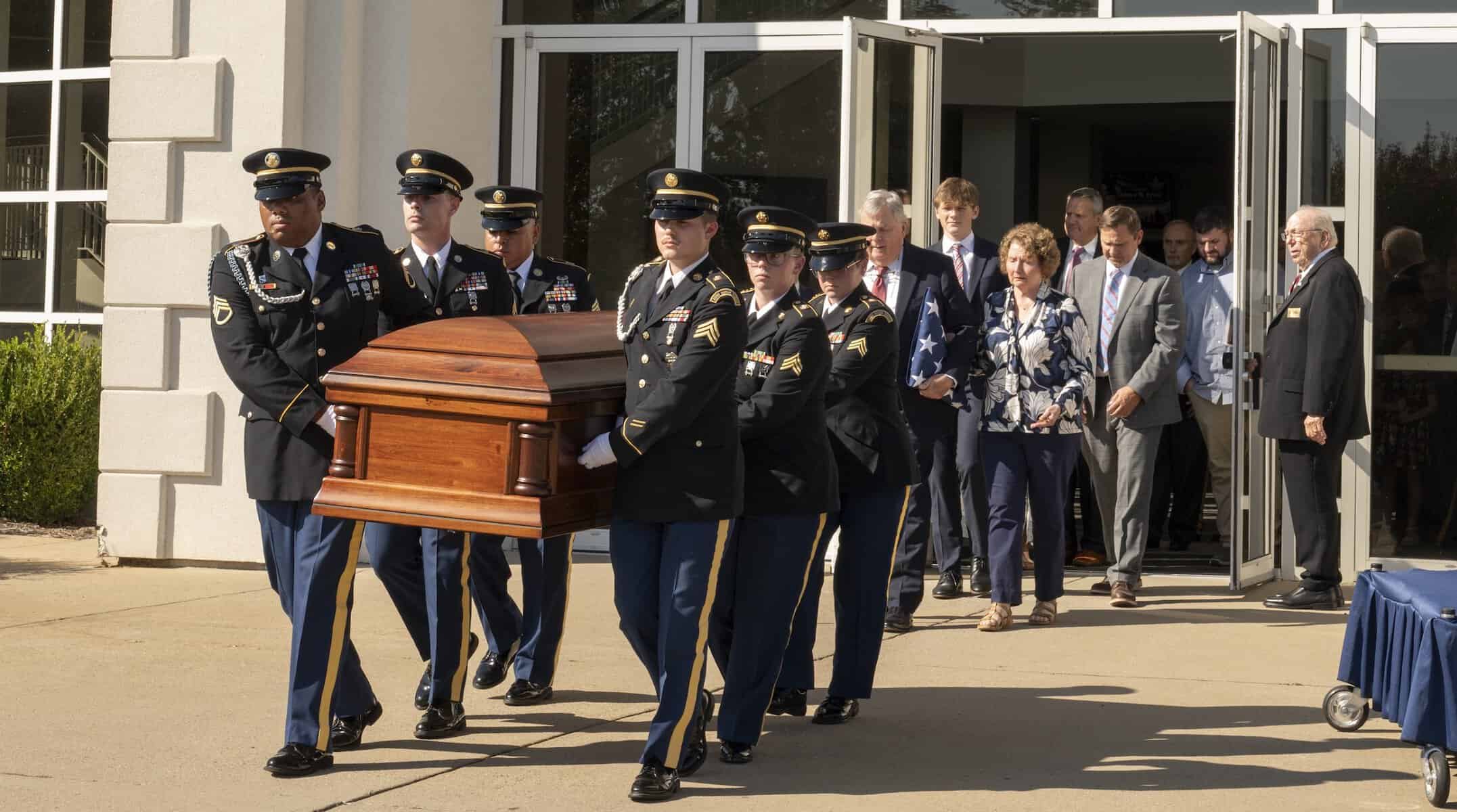
Since World War II, more than 80,000 American service members remain unaccounted for, including almost 1,000 Arkansans. As we honor their service on Veterans’ Day, we also want to recognize service member families. For many, generations of sacrifice mean generations of unanswered questions.
Written by Abby Oliver
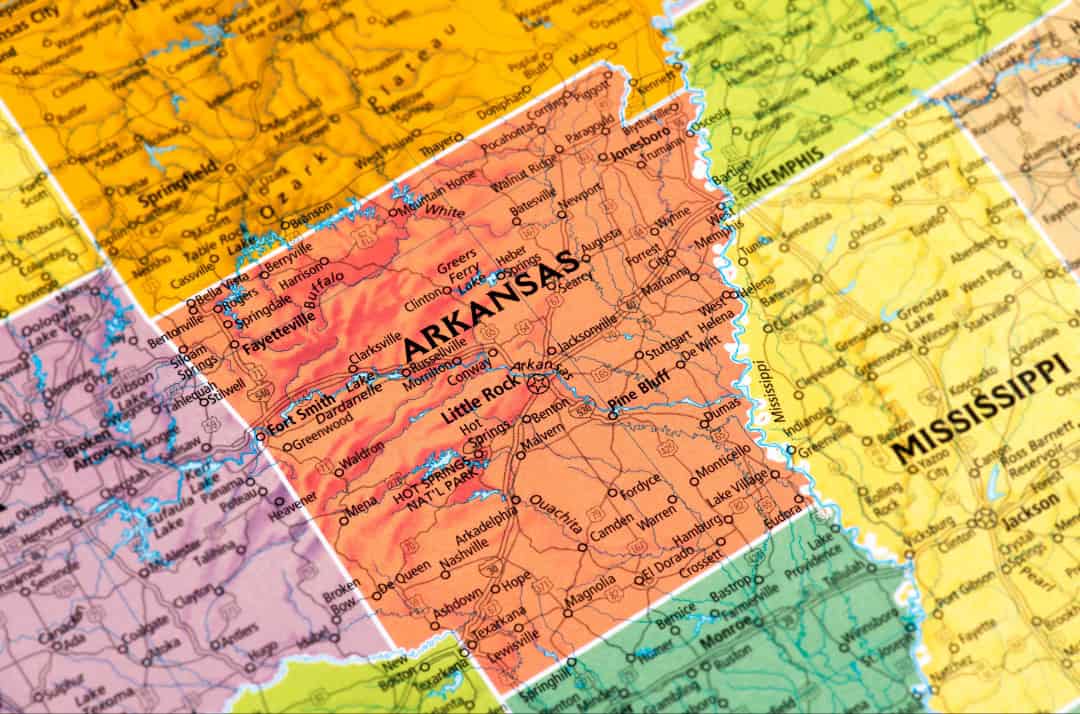
Betty and Jim Monroe Erwin had five children: one daughter, Mollie, and four sons, Beecher, Jack, Charlie, and Delmor. At 18 years old, Delmor worked as a sharecropper on the family farm in Jackson County. In his free time, he played with his nieces, Helen and Betty, and helped them with their homework. At a time when sharecropping brought in as little as $4 a month, the military could offer Delmor much more: $21 a month, food, clothing, and the opportunity to serve his country when he was needed most.
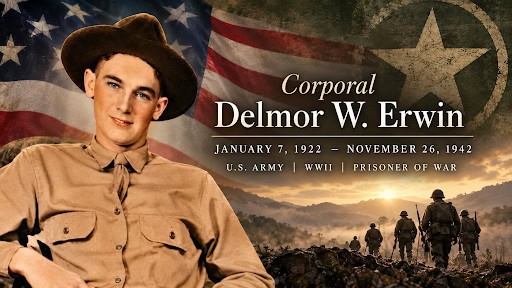
In a letter from Delmor’s brother, Charlie, to their mother Betty, he writes, “I hope you got the money I sent home. I know when Delmor gets to the islands he will send some, too.” On February 5th, 1941, Delmor Erwin enlisted in the U.S Army. He was assigned to serve in the Philippines with Company E and the 31st Infantry Regiment, also known as”The Polar Bears.”
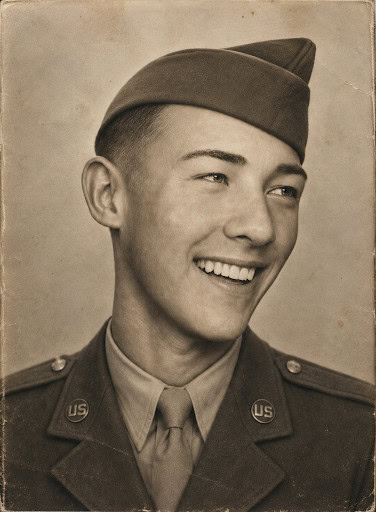
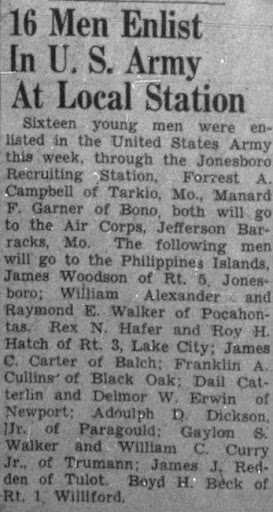
Images courtesy of the U.S. Army Honor Roll Profile and the Defense POW/MIA Accounting Agency Service Profile
According to Army Major Tony Francia, Corporal Delmor Erwin was “a rifle-company infantryman—the core of ground combat power.” He carried a rifle, ammunition, canteen, and a pack through the jungle, across open fields, and over mountainous terrain. He was responsible for maintaining weapons, digging foxholes, conducting patrols, and advancing or defending under artillery or machine-gun fire. Chronic illness and rations made these difficult tasks even more so.
In December 1941, Corporal Erwin and the 31st Infantry Regiment served as part of the Bataan Defense Forces, also known as the Luzon Force, a combined American and Filipino military command that fought the Imperial Japanese Army. Over the following months, disease, starvation, and a lack of reinforcements weakened the force.
The group surrendered to the Japanese on April 9, 1942, and roughly 12,000 Americans and 60,000 Filipinos were forced to march 65 miles across the peninsula. The march lasted several days, with temperatures exceeding 100°F and little to no food or water. Those who did not keep up were beaten or killed. Others succumbed to exhaustion, starvation, or disease. This march would later become known as the Bataan Death March. Corporal Erwin survived this brutal trek, but was imprisoned at the Cabanatuan Prison Camp in horrific conditions. He died of malaria on November 26th, 1942, at only 20 years old.
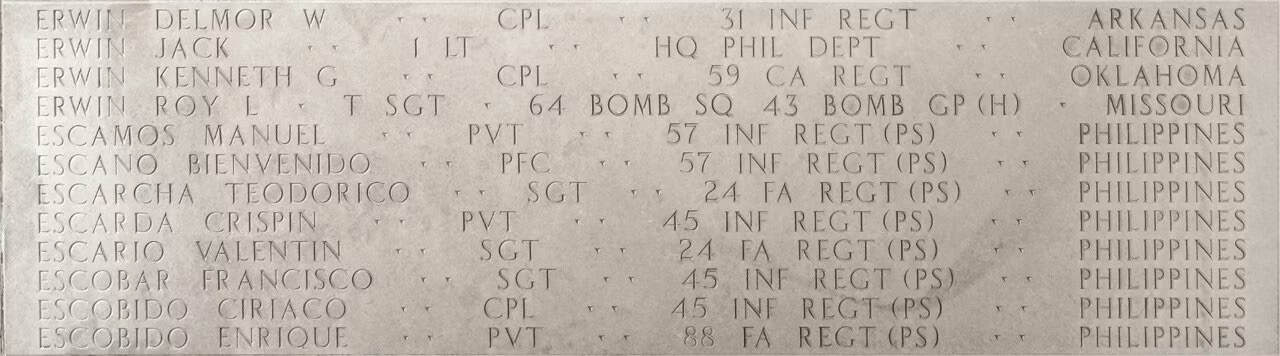
His remains were buried alongside other prisoners of war at the Manila American Cemetery and Memorial in the Philippines. Almost 17,000 American service members are laid to rest there, making it the largest U.S. military cemetery overseas. His name was enshrined alongside 36,000 others on the “Wall of the Missing.” While his family had been notified of his death, the U.S. army was unable to identify which remains were his. For Corporal Erwin’s family, many questions remained.
Eighty-Four Years of Remembrance
“The world changed; generations were born; wars began and ended,” says Corporal Delmor’s great nephew David Evans, a retired Air Force Lt. Colonel. “Presidents came and went. Our family grew and changed, but Delmor was still out there.” Throughout it all, his family remained determined to keep his memory alive. “For 84 years our family has carried his memory.”
Until she died, Delmor’s mother, Betty, told the story of the last time she saw her son. Carolyn Erwin, her granddaughter-in-law, recalls her saying: “‘I remember sitting on the front porch of our house and seeing him walk down the gravel road. He was getting a ride to go enlist for the war. There were cotton fields on each side of the road and he would walk for a few yards before turning around and waving and beginning to walk again. He did this until he was completely out of sight.’” Before her death, Betty arranged for a memorial marker to be placed between her burial plot and her husband’s, in the hopes Delmor might one day come to rest between them.
Brother Charlie Erwin kept a painted portrait of Delmor hanging above his desk, and his niece Helen “remembered him like it was yesterday.” Sadly, his parents and siblings didn’t get to welcome him home, but the stories they shared lived across generations.
Finally, Home
Just over a decade ago, the military contacted the Erwin family to let them know they had begun exhuming group grave sites overseas and transporting the unknown remains back to the U.S. Because of advancements in genetic testing, the military hoped to identify missing service members.
At the time, two of Delmor’s cousins were still alive, along with his nephew, Jim Erwin, Jr. Four family members provided DNA samples. As each year went by, the family received updates that the search continued. On March 25, 2026, Corporal Delmor Erwin’s remains were officially identified following forensic analysis at a military facility in Hawaii. Just six days later, the Defense POW/MIA Accounting Agency notified his family that he was finally coming home.
Carolyn describes the months leading up to Delmor’s return as “a touching, emotional, exciting journey,” emphasizing that the process “definitely didn’t happen overnight.” When the military offered for his remains to be buried in Arlington or at another military cemetery, the family was honored. “There was no question about where he was going to be buried,” she says. “We wanted him in Shirley, Arkansas, between his parents… [who] always hoped to see him come home.”
To prepare for his homecoming, Carolyn worked tirelessly to learn more about Delmor, to understand how he lived and what he experienced. She compiled photographs, letters, and memorabilia from relatives. She spent hours researching and listening to interviews with survivors to better understand what he endured. This was important to her because when the time came to lay Delmor to rest, she wanted him to be “more than a name on a wall.”
On October 9, 2026, Corporal Erwin returned to Arkansas for the first time in more than eight decades. His casket arrived at Bill and Hillary Clinton National Airport in Little Rock, where military personnel, family members, and the Arkansas Patriot Guard Riders waited to escort him. Randy Crownover, who coordinated the escort, recalls the extraordinary, “almost presidential”, show of respect on the day of Delmor’s return. Twenty eight motorcycles and several cars took part in the procession, whilst law enforcement helped clear the route through Little Rock. Crownover describes it as both peaceful and emotional, “the unity in the purpose of us being there, doing what we did as one body, [that] always stands out.”
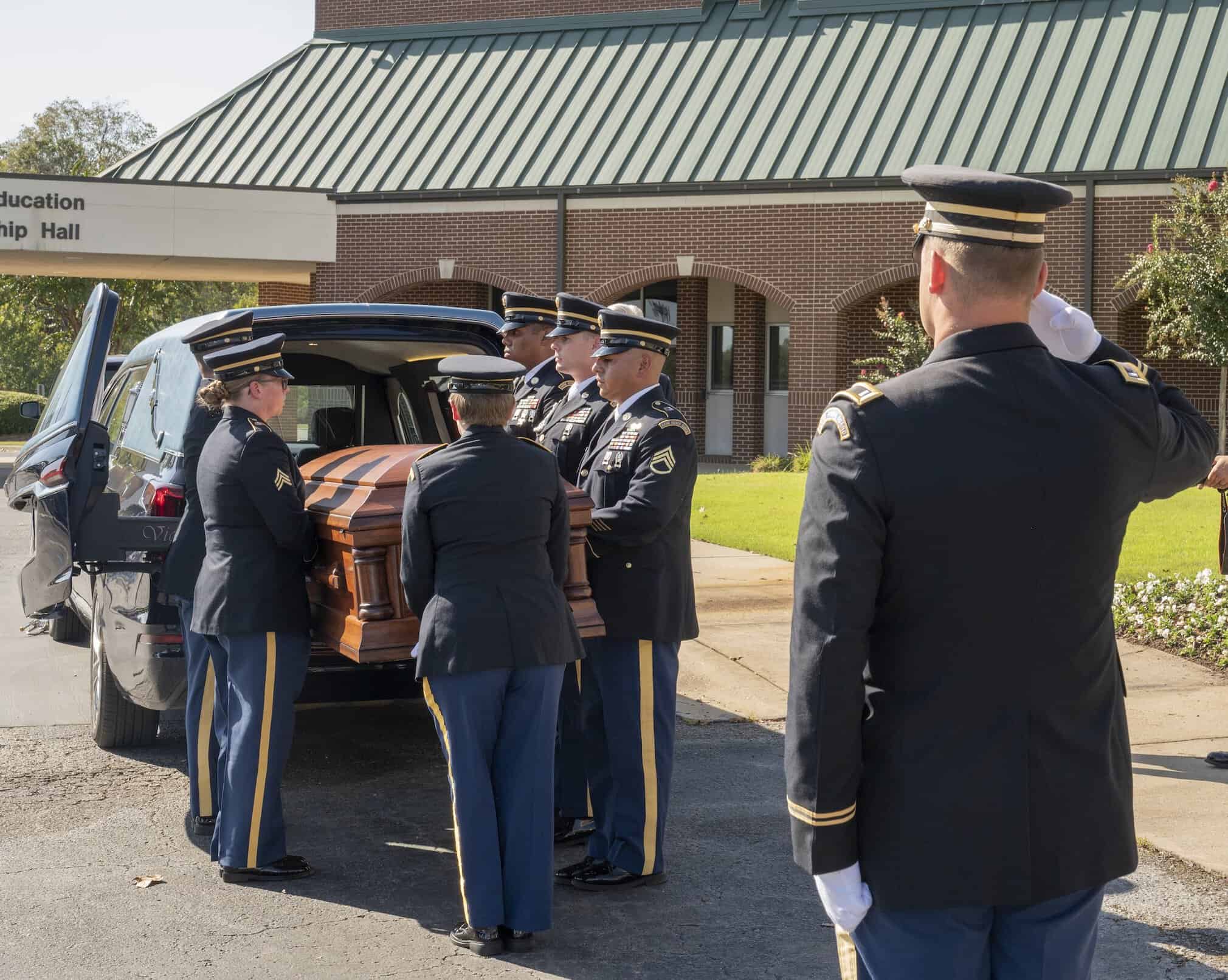
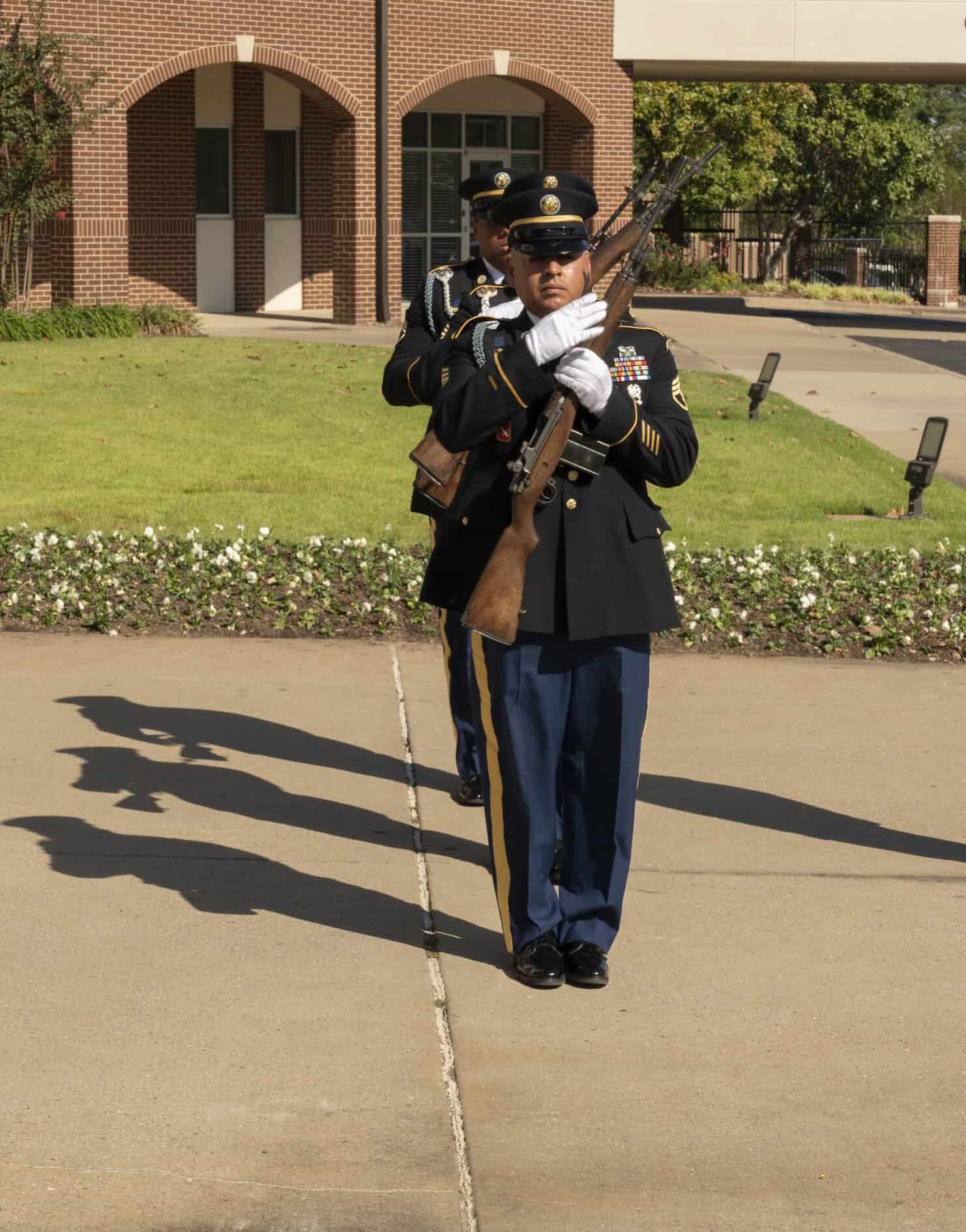
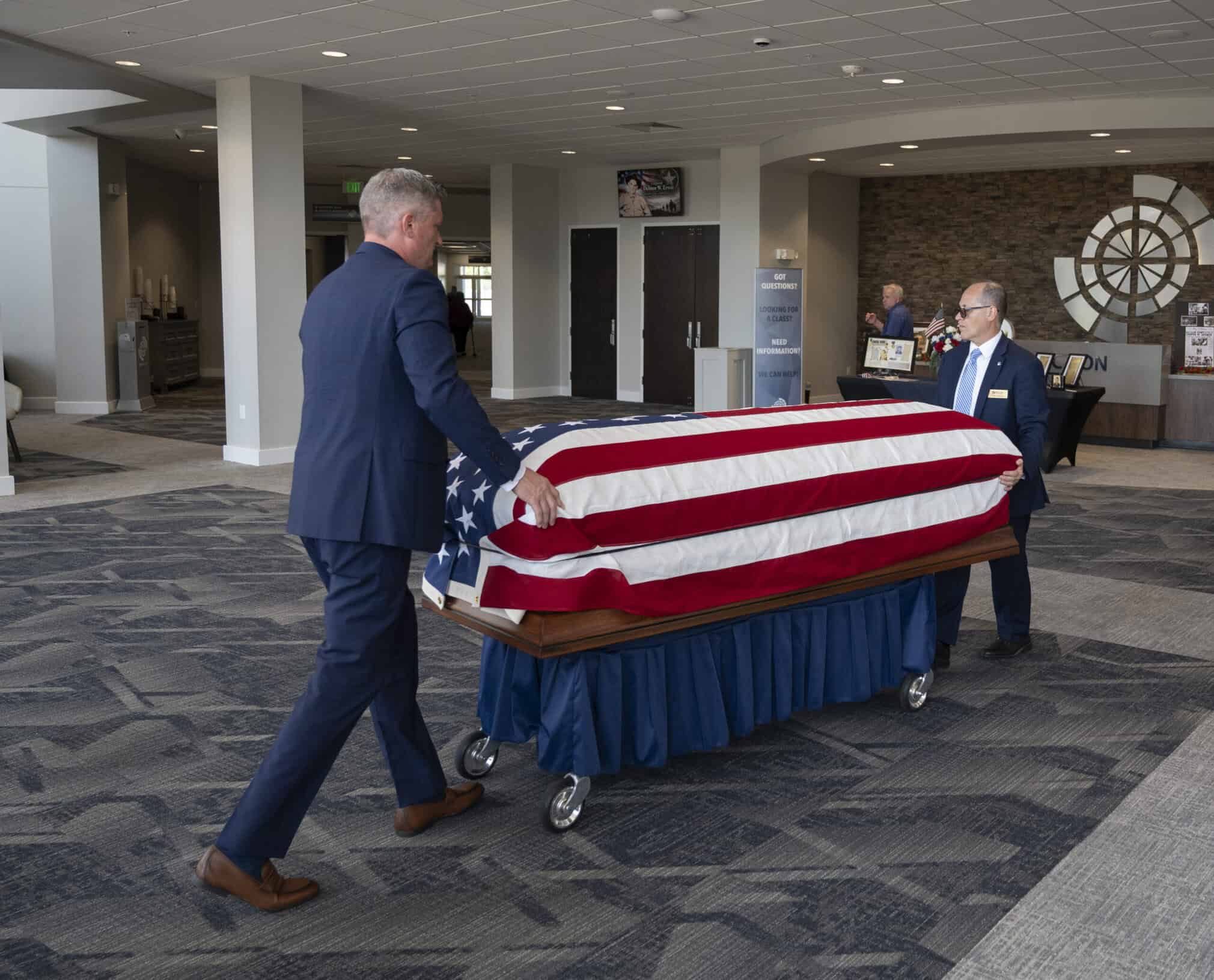
On October 15, 2026, family and community members gathered at Geyer Springs First Baptist Church in Little Rock to celebrate his life. The ceremony brought together relatives ranging in age eight to eighty, a reminder of just how many generations have carried his memory. The words spoken by Delmor’s great nephew, Retired Air Force Lt. Colonel David Evans, are appropriate to share today:
Freedom isn’t an abstract idea, somebody pays for it…If you really want to thank a veteran or someone serving today, I would ask you to do something more. Be an American worth defending. Be a good neighbor. Take care of the people around you. Celebrate this great nation we have been blessed to live in. Look for the good…find the positive things happening in your community and become a part of them. Treat people with dignity. Treat people with decency. Remember we can disagree with one another without becoming enemies. This country isn’t perfect. It never has been. The best way to honor their sacrifice is to make sure this country remains a country worth defending.
Watch the full ceremony.