
A University of Arkansas-Pulaski Technical College graduate encourages students to take advantage of the resources and tools available to help them succeed on campus.
Written by Jessica Crenshaw
Arkansan Jonathan Grigsby got his start in Pine Bluff, but spent most of his childhood in Kansas City, where he absorbed the jazz and arts of the “Paris of the Plains.” In his last semester of high school, Jonathan and his mom moved back to Pine Bluff to support his grandmother. He completed his high school education at Dollarway High School in 2008. Jonathan opted to stay in Arkansas for his education after realizing “it would be more affordable to go to a college in the state where you graduated [high school] from.”
Jonathan graduated earlier this month from University of Arkansas-Pulaski Technical College (UAPTC), where he studied cybersecurity. He now hopes to inspire his younger family members to continue their education, too. “I want to be an example for my nieces and nephews,” he explains. “Being a first-generation student, there’s a lot of pressure, but I want to let my family know—if they decide to go to school, even later in life, it’s doable.”
In Arkansas 41.8% of college students are the first members of their families to attend a college or university. First-generation students often lack the family knowledge that legacy students take for granted. Research shows that 33% of first-generation students drop out within three years, compared to just 14% of continuing-generation students. Jonathan is eager to share the keys to his success, encouraging students to take advantage of the resources available on campuses across the state. He says there are tools to help students navigate the ups and downs of college life. One he credits with helping him the most is the campus food pantry.
First-generation college students are more likely to experience food insecurity, yet most of them don’t know their campus has a student food pantry. Jonathan learned about this vital resource through flyers on campus and was surprised that a food pantry was available for students. “I was a little taken back,” he says.

He recounts asking himself, “Should I go to a pantry? You know, is it going to be okay? I don’t want to be looked at funny.” Ultimately, he decided not to worry about it, and the food provided by the pantry became a lifeline. “The meal I was able to make for Christmas and Thanksgiving, I was just so thankful,” he says.
All state schools in Arkansas host a student food pantry of some kind. Samantha Collins at the Arkansas Hunger Relief Alliance organizes an annual Arkansas College Hunger Summit to bring awareness to the food resources available to students on campus. “Campus pantries across the state are finding innovative and creative ways to break stigma, so that visiting a pantry is as normal as visiting the library or going to tutoring.”
Many pantries are available for both students and staff. Jonathan said the pantry on campus made it easy and he hopes others will learn about it. “Go to the pantry and fill out the application,” he says. “I mean, I know it can be a little bit embarrassing at first thought, but it’s here for us to utilize.”

Beyond the food pantry, Jonathan says the Arkansas Academic Challenge Scholarship, funded by the Arkansas Scholarship Lottery, helped his financial and mental wellbeing. “You know, one of the biggest worries is: How am I going to pay for this?” He said the financial relief he felt allowed him more time to focus on his schoolwork and less time wondering how to make ends meet. An advisor on campus told him about the scholarship opportunity, and workshops on campus helped him navigate the application. He says the process was simpler than he expected. “I was so enthusiastic,” he says when he got the good news. “Okay! Now there’s something less I have to think about.”
When asked what he’d say to a student thinking about attending school: “Just do it!” he exclaims. “Because to have a better education opens up more opportunities.” Now that he’s graduated, Jonathan’s not sure if he’ll stay in Arkansas. “I enjoy traveling,” he says. “I considered moving back to Kansas City, but you know, that’s where I lived my full life with my grandma and she’s no longer with us. So, maybe I’ll just explore more of the world and see what else is out there…she was a traveler, too,” he says and smiles.

Learn More About Scholarships:
The Arkansas Scholarship Lottery has provided more than $1.6 billion in proceeds for Arkansas students, awarding more than 873,000 scholarships. Despite the broad reach, many students are still unaware of the scholarship program, and rural students are less likely to apply even though the application process is relatively simple. The Arkansas Department of Higher Education (ADHE) administers several scholarship programs for Arkansas residents, funded by the Arkansas Scholarship Lottery:
Arkansas Academic Challenge Scholarship:
Provides educational assistance to residents pursuing higher education, regardless of academic status. The application deadline is July 1.
Arkansas Workforce Challenge Scholarship:
Offers financial assistance for certificate programs in high-demand occupations. Applicants must apply at least 30 days before enrollment and cannot already receive the Academic Challenge Scholarship.
ACCESS to Acceleration Program:
Replaces the Concurrent Challenge Scholarship and will be phased in through Fall 2029.
The ADHE selects scholarship recipients. Interested students can apply at sams.adhe.edu or contact ADHE at 501-371-2000 or fi****@**he.edu for more information.
Learn More About Campus Food Pantries:
Each year, the Arkansas College Hunger Summit, hosted by the Arkansas Hunger Relief Alliance, brings together students and campus leaders to learn from one another and workshop solutions to college hunger. “It’s free to attend, and there are grant opportunities for campus pantries, so they can keep meeting students where they are!” says organizer Samantha Collins.
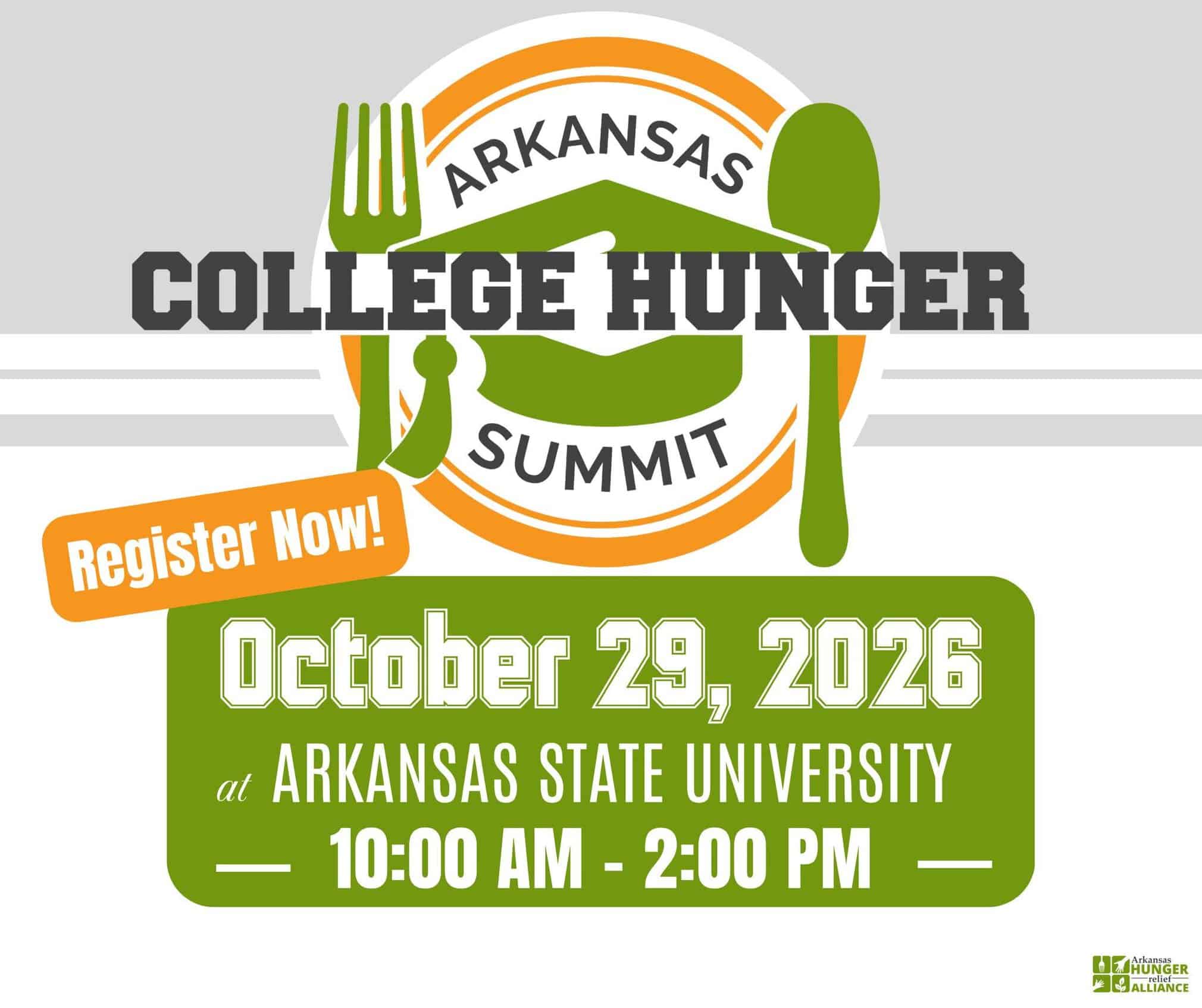
The next Summit is on Thursday, October 29, 2026, at Arkansas State University in Jonesboro.