Mention barbecue to just about anyone, and they’re guaranteed to have an opinion. As events, Arkansas barbecues have always been social affairs, but what we think of when it comes to barbecue today differs in meaning and context from its roots centuries ago.
Written by Kat Robinson
Barbecue in Arkansas these days means pork, beef, and chicken (sometimes turkey!), slow-cooked with fragrant wood smoke for hours and then shared with friends and family. The roots of the technique trace back to indigenous peoples centuries back; we know in particular the Casqui population based at what is today the town of Parkin (Cross County) served smoked fish to Spanish explorer Hernando de Soto when he arrived in the area in 1541, and that smoked white-tail deer was a top protein source for the tribe.
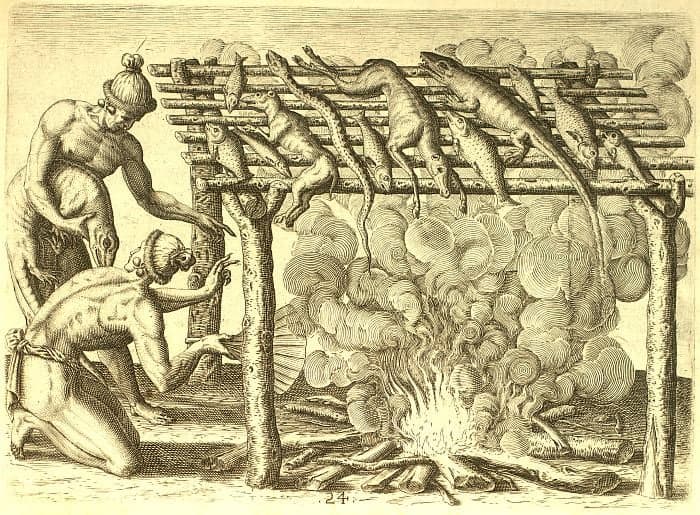
The idea of smoking meats carried over to enslaved people in Arkansas and has been well-documented by historians and food writers. The first pitmaster, or rather, pitmistress, documented in Arkansas food history was a formerly enslaved woman named Mary John. Historian Adrian Miller in his book Black Smoke: African Americans and the United States of Barbecue thoroughly explored the threads of her history, including a barbecue she presided over in Pine Bluff in 1840. John purchased her own freedom and operated a public house at Arkansas Post. Her obituary in the Arkansas State Gazette on June 6, 1857 mentioned her “fine coffee and venison steaks.”
Barbecue in the 19th century
The meats smoked in our past are demonstratively different from those in our cabinets and pits today. My own research—including hundreds of hours delving into old newspapers, books, oral histories, phone books, and obituaries plus visits to more than 400 contemporary barbecue restaurants in Arkansas—paints a vivid picture.
In his book The History of Arkansas: A Text-Book for Public Schools, High Schools, and Academies, published in 1905, Josiah Hazen Shinn wrote this passage in a section titled “Liberation of Texas”:
One of the most noted Arkansas gatherings of territorial days was a barbecue given in the interests of this republic by John Bowie, at his plantation below Helena. Invitations were sent to all parts of Arkansas and to the Indian nation. The barbecue lasted three days and was attended by hundreds of the richest planters, and by a numerous crowd of adventurers. Speeches were made by prominent men from Mississippi and Arkansas, a large sum of money was raised, and several companies of men were recruited, who started at once for the scene of war. These men were familiar with the forest, and knew how to handle the rifle and the bowie knife, hence they made effective soldiers in the contest that followed. (p. 113)
In another book, Pioneers and Makers of Arkansas, published in 1908, Shinn documented the prevalence of barbecues through the state in early territorial years. “The barbecue was a feature of early territorial life, and the pioneers could smell a feast of this kind for fifty miles… A barbecue or a bergu was the social occasion of the period, but politicians soon turned it into a machine for vote-getting and for sampling bad whiskey and worse oratory.” (p. 103)
The Politics of Barbecue
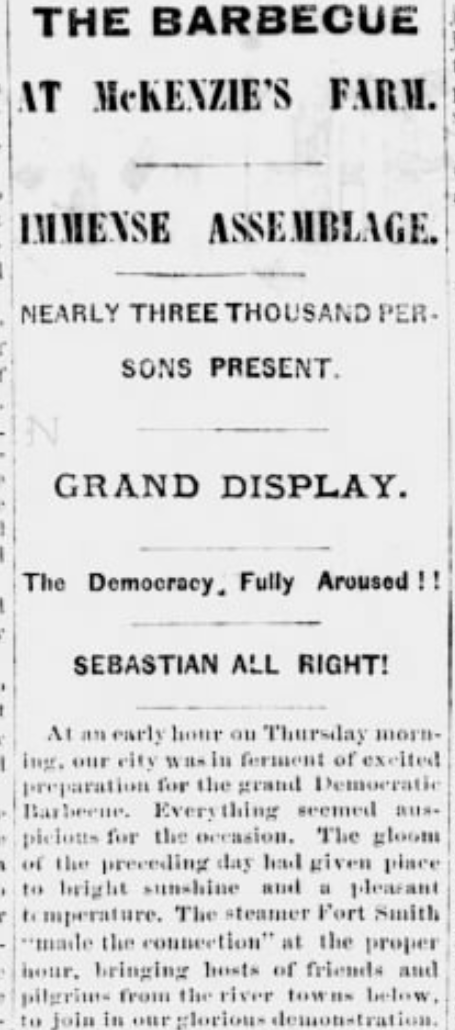
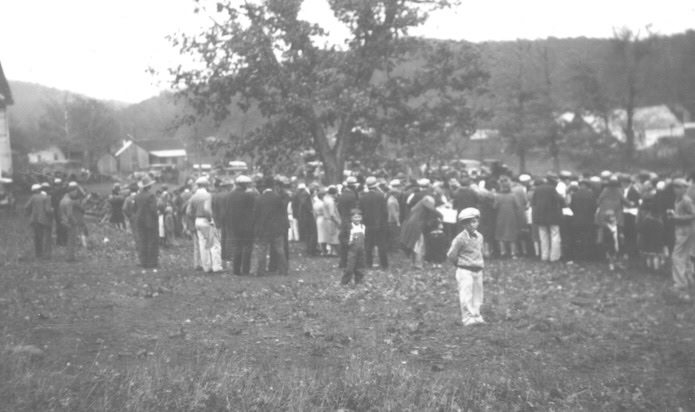
There’s a barbecue Shinn documented in Lawrence County at Fourche de Thomas, but no meat is specified. His descriptions come more than 80 years after the events mentioned, without saying where he heard those things. We do know for certain, though, that barbecues were common throughout the 19th century as political rallies and as gatherings closely tied to elections.
The book Biographical and Historical Memoirs of Northeast Arkansas, published by Goodspeed Publishing Co., relates a similar event. Mrs. Leister E. Presley in Searcy in 1889 described a gathering held in Pocahontas on the creation of Randolph County. “The election was held in the summer or fall of 1836,” she recounts, “at which occasion Messrs. Drew and Bettis gave a free barbecue at the site of Pocahontas, and, as men could then vote at any voting place in the county, the barbecue provided a sufficient inducement to draw voters enough to secure a small majority in favor of locating a seat of justice at the latter place.” (p. 365). Once again, another barbecue recollection of an event that took place 50 years before.
To learn more about barbecue in the 19th century for contemporary accounts, we turn to newspaper archives.
An article in the September 4, 1839, Arkansas State Gazette mentions an upcoming “Democracy Barbecue” that day, in which “large stores of beef, sheep, pigs, and poultry, have been provided by the industrious farmers of the county, together with all things suitable for drinking.”
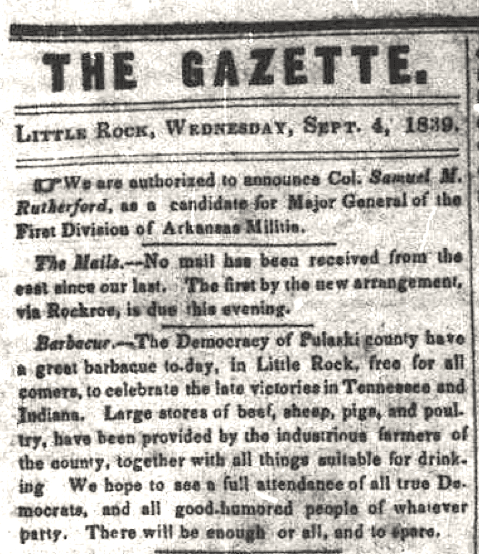
A story published a week later mentions “the Democratic farmers of the county sent in large quantities of the right sort of provisions, and several of our expertest hunters turned out the day previous, and killed four fine deer, which helped out the board in an abundance of venison.” It goes on to say “the cooks did their duty; the meats were done to a turn, although roasted by wholesale, and all the other eatables prepared for the occasion, were cooked in a style fit for the table of the most fastidious epicure.” Roasting is the only particular method mentioned in this piece.
Public barbecue celebrations were not limited to white populations.
In Born in Slavery: Slave Narratives from the Federal Writers’ Project, 1936-1938, Will Glass of Little Rock shared his family histories, including this account…
Both of my grandfathers said their masters used to give picnics. They would have a certain day and they would give them all a good time and let them enjoy themselves. They would kill a cow or some kids and hogs and have a barbecue. They kept that up after freedom. Every nineteenth of June, they would throw a big picnic until I got big enough to see and know for myself. But their masters gave theirs in slavery times. (p. 43)
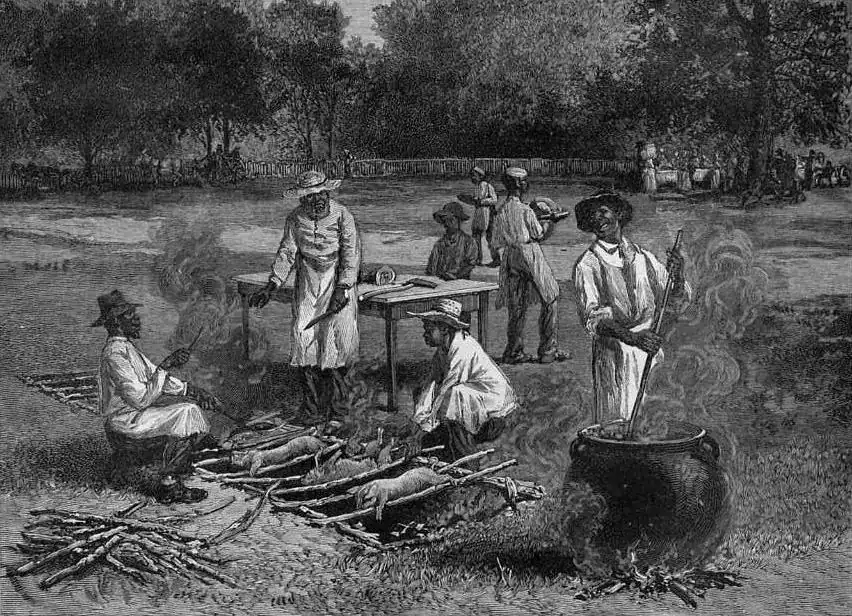
Most articles I’ve found while researching barbecue in the mid-19th century focused on the texts of speeches given by political candidates and community leaders. Very little information is found on what food was served and since barbecue attendees did not document what they ate, determining exactly what meats were used in barbecues prior to 1860 is difficult.
1840-1860s
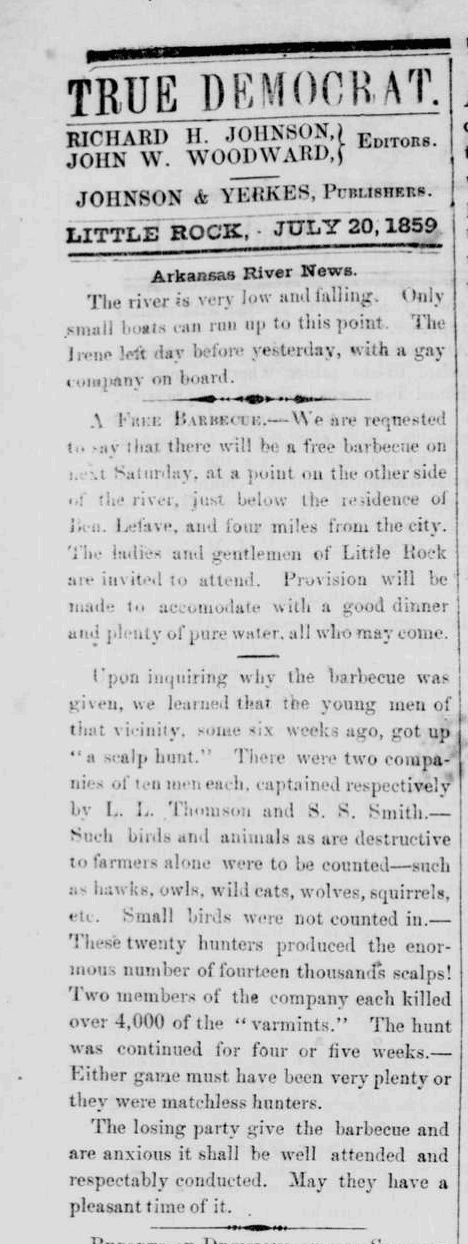
Digging through 143 newspapers that mentioned barbecue between 1840 and 1860, only four articles mention the meats used. One story, dated July 20, 1859, from the Arkansas True Democrat shares the prowess of hunters as a reason for a free barbecue at the home of Ben LaFeve on the north side of the Arkansas River in Pulaski County. “Upon inquiring why the barbecue was given, we learned that the young men of the vicinity, some six weeks ago, got up a ‘scalp hunt.’ There were two companies of ten men each, captained respectfully by L. L. Thomson and S. S. Smith. Such birds and animals as are destructive to farmers alone were to be counted – such as hawks, owls, wild cats, wolves, squirrels, etc. Small animals were not counted in. These twenty hunters produced the enormous number of fourteen thousand scalps!”
The other three mentions are all from September of 1859. On September 3, an Arkansas State Gazette article notes an event at Mrs. Weaver’s house on the Fourche River, “the Barbecue was given by the citizens of the neighborhood as a celebration of the successful termination of a hunting party for the purpose of killing each vermin and birds as prey upon the crops. Eighteen thousand scalps were taken.”
The Arkansas True Democrat, in a piece published on September 17, made mention of a barbecue held at Fourche on the day of publication, “we hunted FIVE WEEKS, and killed nineteen thousand, seven hundred and sixty five scalps, mostly squirrels.”
A third article, published in The Arkansian, a newspaper in Fayetteville, detailed an event at Clear Creek, located northeast of Fayetteville. “The pigs have got to be throat-cut, the chickens to be head-cut, and the loaves and fishes to be divided and devoured, all to win over unto Him those eating thereof.” The last of these including the loaves and fishes phrase indicate a license of Biblically-inspired poetry. The ones before, though, prove that barbecue at this time and place was mostly wild game, harvested to prevent crop damage and feasted upon at events that usually included oratory and spectacle meant to sway citizen voters to support their candidate or religious cause.
After the Civil War
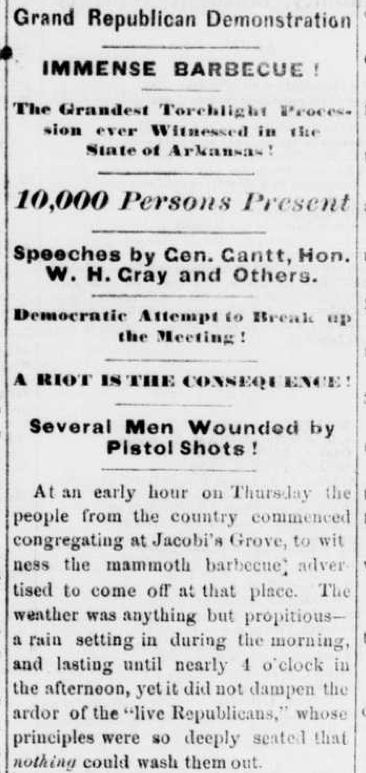
The Morning Republican newspaper in Little Rock published an article on July 25, 1868, that did report some of the food served at a large, unruly barbecue at Jacobi’s Grove, which was located near 11th Street and Dr. Martin Luther King Jr. Drive. Dinner was served after a speech by the Honorable O.P. Snyder, a member of the U.S. House of Representatives. “As soon as he descended from the stand, dinner was announced and the sea of heads surged to and fro like a wave of the sea, until they rested quietly beside the long line of tables piled with their growing load of – not army beef – but nicely barbecued beef, pork, and mutton. The persons having charge of the barbecue provided refreshments for five thousand persons, and yet that amount was wholly insufficient for the immense crowd; while at the contrary to the little affair of the democracy, like the miracle of seven baskets full of fragments, of their little store, over seven times that amount was gathered up.” The larger-than-expected gathering heard more speeches, at one point taking up torches to walk the streets in parade, and when a hook-and-ladder company responded to a fire bell sounding, a brou-ha-ha commenced, with a couple of men being shot. It wasn’t over the food, though.
References to different kinds of meat are first found in articles after the Civil War.
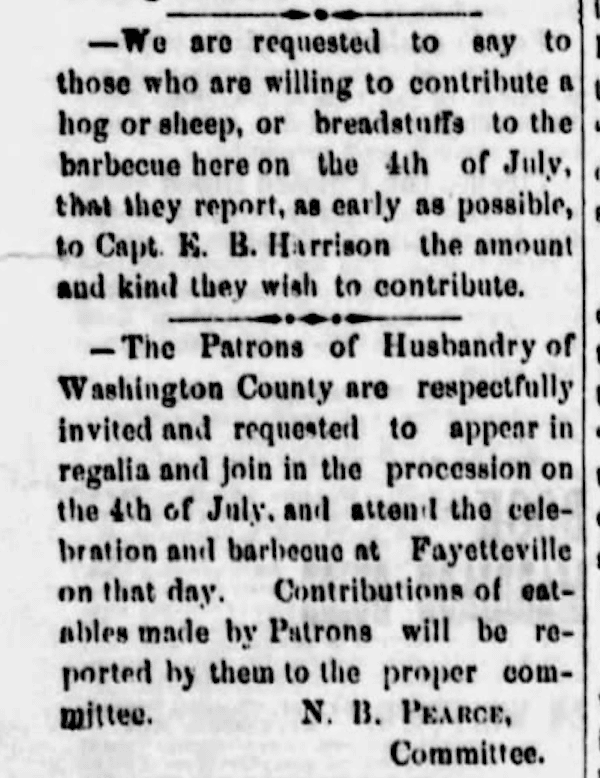
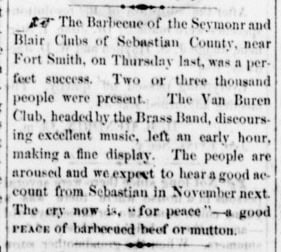
Left: A call for hog, sheep and bread for a 4th of July barbecue, Batesville Guard, August 9, 1887. Right: A “cry for peace,” and mutton in Van Buren Press, September 18,
In the Van Buren Press on September 18, 1868, there’s a reference to the Seymonr (sic) and Blair Clubs of Sebastian County holding a barbecue, referencing “the cry now is for peace: a good peace (sic) of barbecued beef or mutton!” Horatio Seymour and Francis P. Blair, Jr. were the Democratic presidential and vice-presidential nominees in 1868, running against Reconstruction policies and losing to Ulysses S. Grant.
We see a shift over the next two decades. While in the 1870s, references to barbecues as being meats served, or meats and breads served grew, descriptions of foods served at social barbecue gatherings increased over time and fewer speeches were recorded word for word. Instead, meals and activities became more commonly mentioned. Some, like a piece published in August 2, 1873, edition of The Osceola Times, references gander pulling (where men on horseback would attempt to remove the head of a greased goose while at full gallop) and a greased pig race. Over time, there are more references to gospel singings and fairs, predecessors to the festivals we enjoy today.
By the 1880s, barbecue mentions often included the meats served and, for someone who grew up in the latter half of the 20th century, those meats were a surprise. On July 18, 1885, an Osceola Times article began, “the choicest of the heards [sic] of cattle, sheep, and swine of the community had been slaughtered, the poultry yards have been despoiled of their tenderest cockerels and juiciest pullets, and during all the night before, men and women had been employed in watching and supervising the cooking and barbecuing over the pits; the grounds had been cleaned off, tables set, a platform for the dancers and a stand for the musicians erected, and all was in readiness for the day fixed for the Barbecue by the merchants and businessmen of Osceola.” The event had by this point evolved into an official meal centered on pit-cooked meats.
Sheep was a common element to barbecues in the latter half of the 19th century.
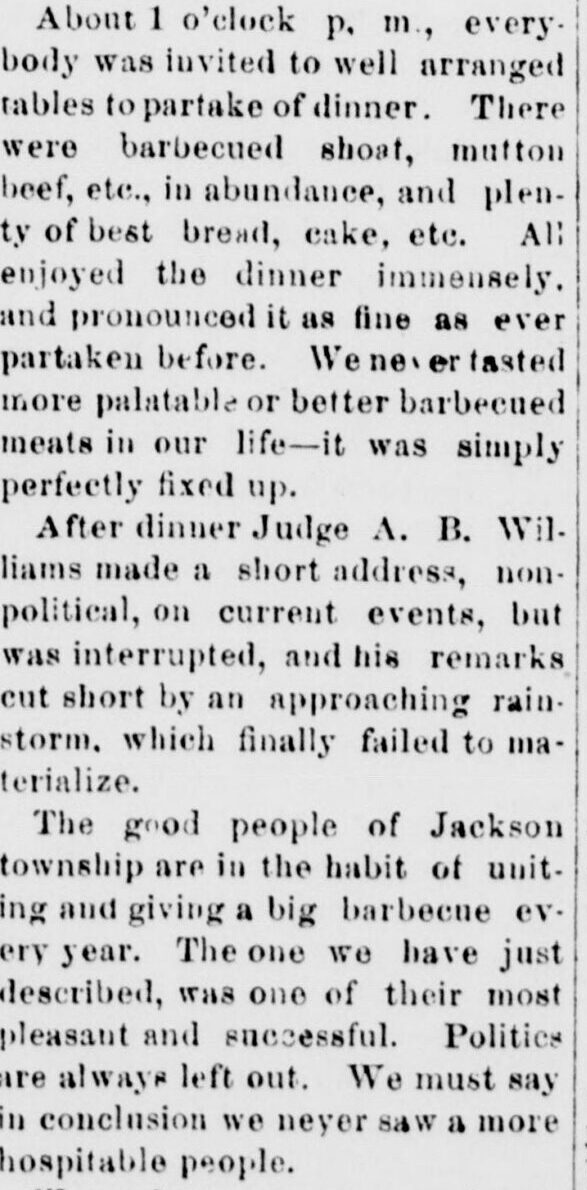
The August 25, 1886, edition of the Nevada County Picayune in Prescott documents the use of mutton. “About 1 o’clock p.m., everybody was invited to well-arranged tables to partake of dinner. There were barbecued shoat (recently weaned pig), mutton, beef, etc. in abundance, and plenty of best bread, cake, etc.” Less direct references also point to sheep as a commonly barbecued meat.
A writer in the June 13th, 1885, Daily Texarkanian alleges a rival reporter got “a leg of mutton and a cup of coffee, free” at the Wilton Barbecue a few days before.
Advertisements for community barbecues start to appear in newspapers near the turn of the century. These free events, coordinated by various committees, celebrated how many people they could pull in. On June 27, 1894, the Pine Bluff Daily Graphic cites a barbecue given at the Good Faith M.E. Church in the Niven community as “the largest ever assembled on a similar occasion in this county.”
Rise of the Restaurant
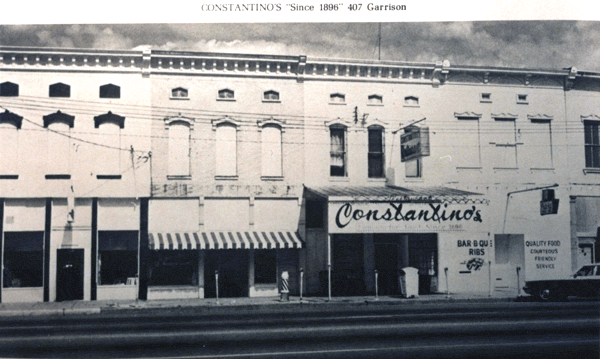
Barbecue restaurants began emerging across the state at the turn of the century. Constantino’s on Garrison Avenue in Fort Smith was an Italian grocery-turned eatery that featured “barbecued beef” and “barbecued pork” at the top of its menu. The restaurant faithfully served the community from 1895 until it officially closed during the 1980s.
In Marianna, a place called “The Hole In The Wall,” opened after 1910 and was the predecessor to the esteemed Jones Barbecue Diner and served roasted and smoked pulled pork. According to business guide Black Business, the diner is believed to be the country’s oldest black-owned restaurant.
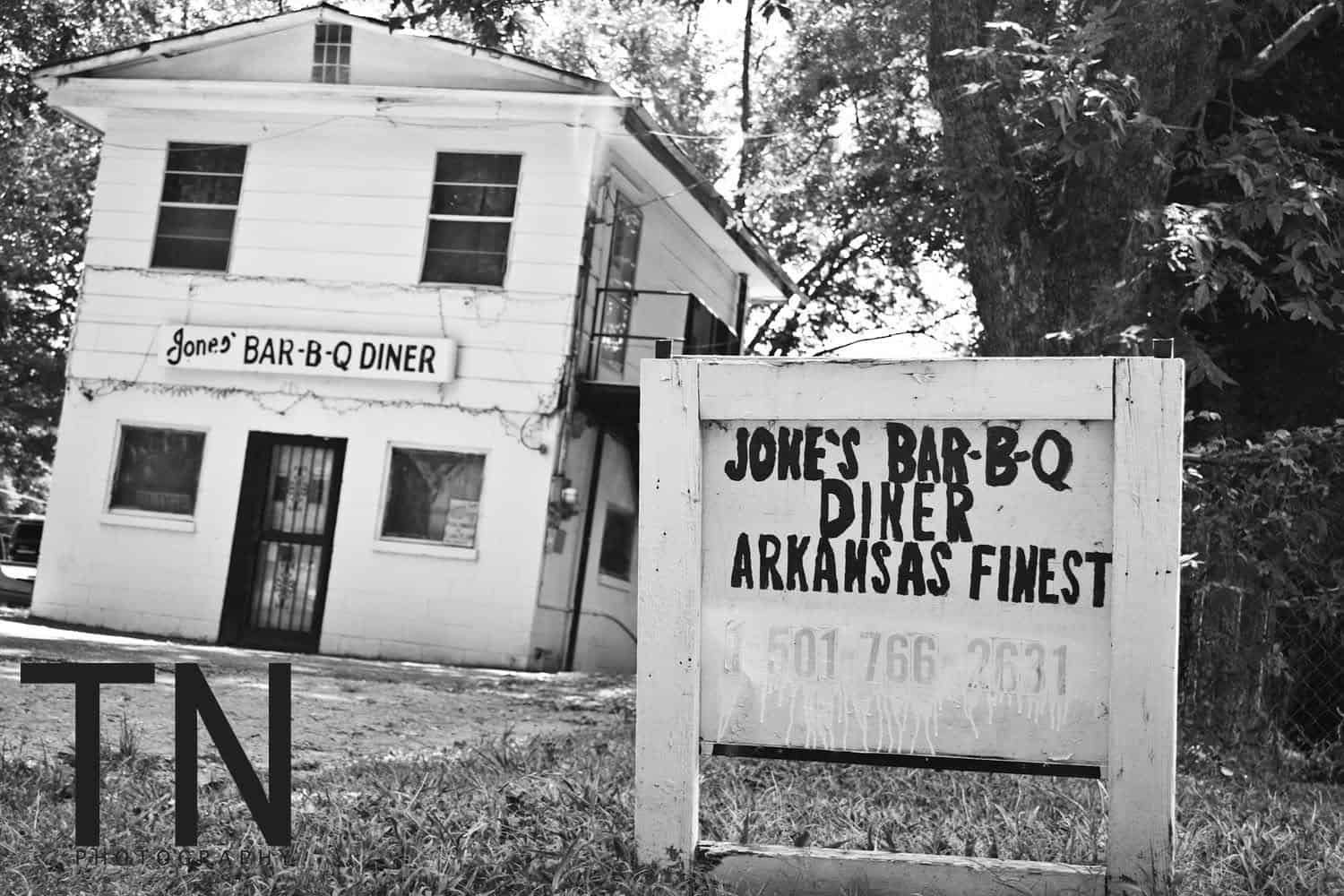
In 2012 it was recognized by the James Beard Foundation as an “American Classic.” Just this month, Arkansas Attorney General Tim Griffin swung by the diner and ordered up four pulled-pork sandwiches, providing commentary for his viewers along the way. Because nothing says “I understand Arkansans” like a campaign stop covered in barbecue sauce.
Within two decades, barbecue had fully shifted to include the restaurants that would carry the dish as their namesake.
Many early barbecue joints featured one or two sorts of meat. During an interview in May 2023, Philip McClard, namesake of the beloved McClard’s Bar-B-Q in Hot Springs, spoke about how his grandparents, Alex and Alice McClard, would smoke and sell barbecued goat and hams, which went well with a sauce provided by a traveler who couldn’t pay his bill after a stay at the tourist court the McClards owned.
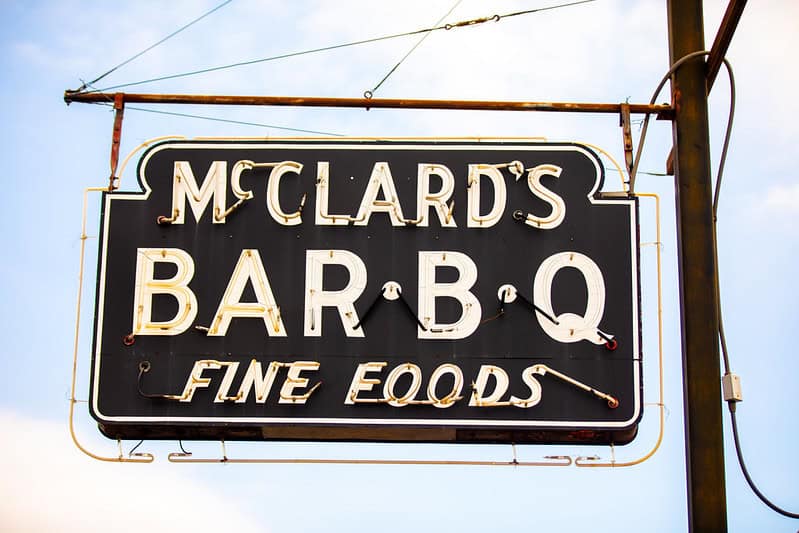
“He gave Grandpa and Grandma a recipe for some sauce, and the sauce was meant for pork or for goat. Grandpa had a guy here in town that raised goats and he would butcher the goats.”
Pork was used and available, but the McClards eschewed pork ribs. McClard explained, “The packing houses that cut ribs back in those days didn’t know how to cut ribs. They just were just falling mainly. Grandpa would hold a slab of ribs out the back door and dogs would come grab it and take off from them, so they would leave them alone while they worked.”
After World War II
After World War II, barbecue moved away from the array of “scalps” and game meats once smoked. Both restaurants and event organizers shifted to a smaller selection—pulled pork and ribs, beef brisket, smoked sausage links, and whole and half chickens. Today, those meats are still the most popular options. Through interviews and menus, I’ve found an almost even split between the popularity of meats in different parts of the state, with pork being the top seller in the Delta, long-smoked, wrapped brisket that falls apart in the timberlands of Lower Arkansas, sliced oak-smoked brisket in the Ozarks, and a new prevalence of smoked turkey breasts and legs, often split and smoked, in central Arkansas.
Our barbecue traditions, which started with pits and smoke, utilized whatever animal proteins were available. Even though the meats have changed, those traditions continue as our gatherings have grown from political grandstands to popular festivals and award-winning restaurants. The smoke goes on.

Editor’s Note: We asked Kat to recommend a few tried and true Arkansas barbecue spots. These are “off the top of my head,” she says. Use the map below to plot your next Arkie BBQ Tour.


Kat Robinson is Arkansas’ original culinary traveler, with three PBS programs, thousands of articles, and fourteen books on food in The Natural State to her credit. The Emmy-nominated documentary host and food historian is currently working on a history of Arkansas barbecue.
Follow Kat: Facebook | Instagram | www.TieDyeTravels.com