
At a time when the national political climate is divisive and “us versus them” in a way that doesn’t easily allow for progress, two Arkansas state senators lead the way by working together.
Written by Jessica Crenshaw
Photographs by T. Logan Keown
The Old State House in Little Rock used to be the place where important Arkansas political decisions were made and our state’s early leaders fought it out (literally). The stately building, now a museum run by the Arkansas Department of Parks, Heritage and Tourism, felt like a fitting place to meet state senators Jonathan Dismang and Clarke Tucker—one is a Republican, the other is a Democrat—and talk about their unlikely friendship and legislative collaboration.
We wanted the 1836 House of Representatives Chamber, a big, dramatic room with a balcony and all natural light. A museum staffer noted there might be a problem; a group of sophomore Gifted and Talented students from Pocahontas were scheduled to take a tour at the same time. Having once been a rural student who took field trips to the big city, I had an idea: “Would the students want to meet ‘the Senators’?”
You bet they did. When I asked who ate free breakfast at school that morning, every student raised their hand. After they learned the two legislators in the room were responsible for those free meals, a wave of surprised gasps and whispered thank-yous quickly became loud cheers. I even saw some teens with tears in their eyes. Following a short introduction, the group swarmed the men for selfies and slang lessons. It was a magical moment.
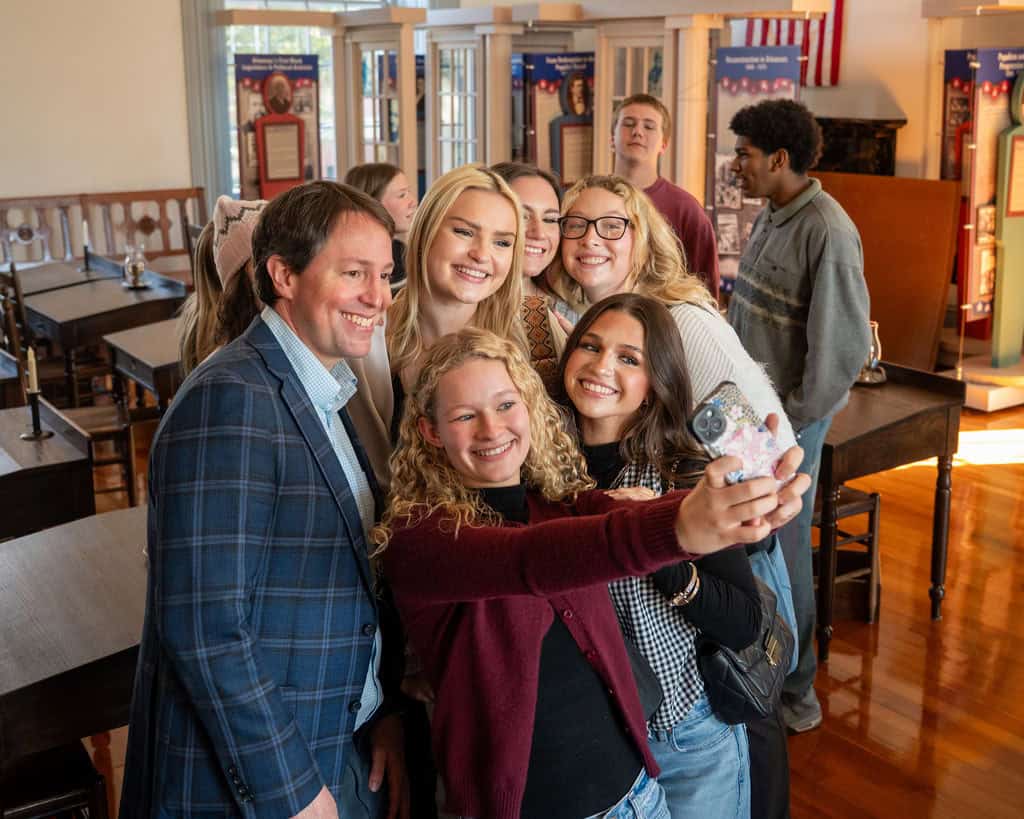

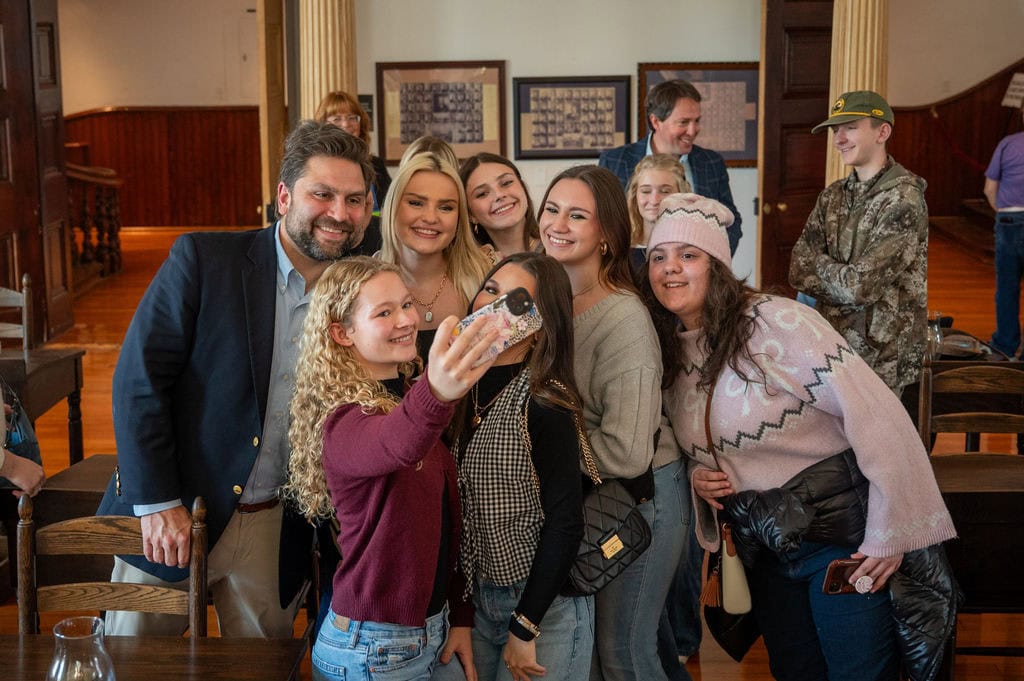
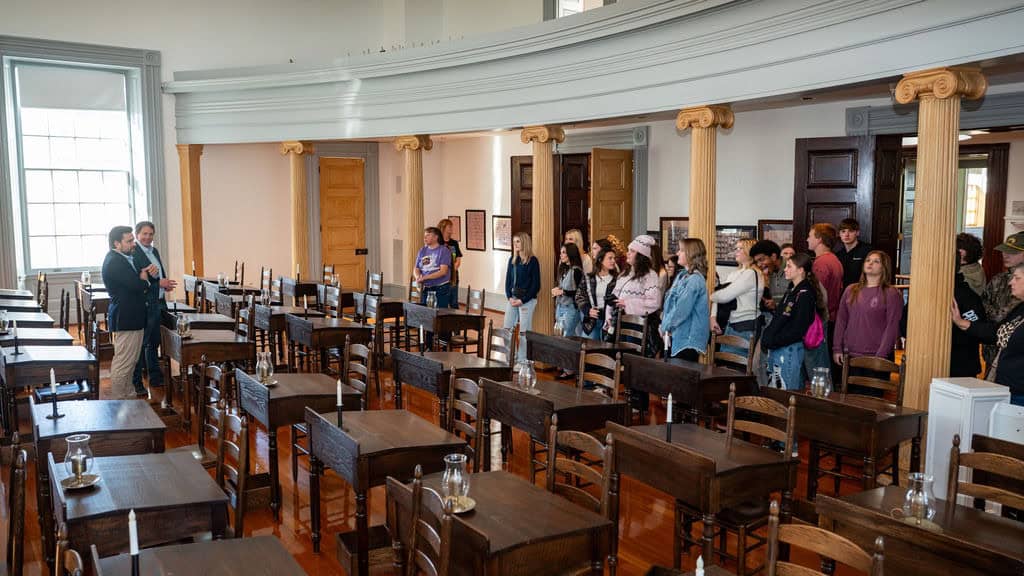
You’d think feeding hungry kids would be a unifying cause for folks on both sides of the political aisle. Groups have been working in Arkansas to bring free school meal legislation to the table for years, but it still took a long time for bi-partisan leadership to make it happen. At a moment when extremes on both sides are name-calling and churning out slanted AI-generated slop on social media, it’s nice that Arkansans don’t have to look far to find the opposite.
At first glance, you wouldn’t think the two men have much in common. On paper the only thing shared? The first three letters of their alma maters—HARvard and HARding, respectively. But even during our short half-hour conversation, the men found plenty of common ground in pet preferences, news sources, and most importantly, their draw to public service.
“It sounds cliché but I’ve always had an interest [in public service],” says Senator Dismang. “ I really enjoyed student government. When I got to Harding, my seat mate in economics class was Tim Hutchinson’s son, Josh.” Hutchinson is the son of former U.S. Senator Tim Hutchinson and nephew of former Arkansas Governor Asa Hutchinson. “I accepted an internship in D.C. and really enjoyed it. I got into the accounting world and just let it sit.” Later, a job at a firm in downtown Little Rock connected him in a different way. “They did a ton of nonprofit work so that allowed me to stay involved with charitable organizations and become somewhat involved in a political scene.”
Dismang was elected to serve in the Arkansas House of Representatives in 2008, and after one term, elected to the Senate.
He moved back to Beebe on the last day possible to run for office. His opponent in the district was his former high school superintendent. “I’ve been in office since,” he says.
Tucker’s motivation is similarly long-lived. “I come from a really civic-minded family,” says Senator Tucker, “and it’s just, I think, part of our family philosophy.” He says politics specifically isn’t a family legacy, but community service is. “My dad has had a whole community-based career in Little Rock, and he’s never run for office once,” he explains.
“So running for office wasn’t necessarily the model, but just caring about the community and doing what you can for the community.” His draw to public service is personal. “I realized that I’ve been given a lot in my life. I have a lot of blessings,” he says. “If I hoarded all of those blessings for myself, I wouldn’t be able to sleep at night or live with myself. So my mission, really, is to make sure that everybody has the same kind of opportunities.”
Tucker was elected to the Arkansas House of Representatives in 2014 and to the Senate in 2020.
Senator Dismang is solid and self-assured. He makes easy eye contact and has a handshake my grandfather would appreciate. Senator Tucker is tall and so soft-spoken, I had to move my recording device closer and found myself leaning forward to hear. They care about Arkansas and you can feel it when they talk to one another.
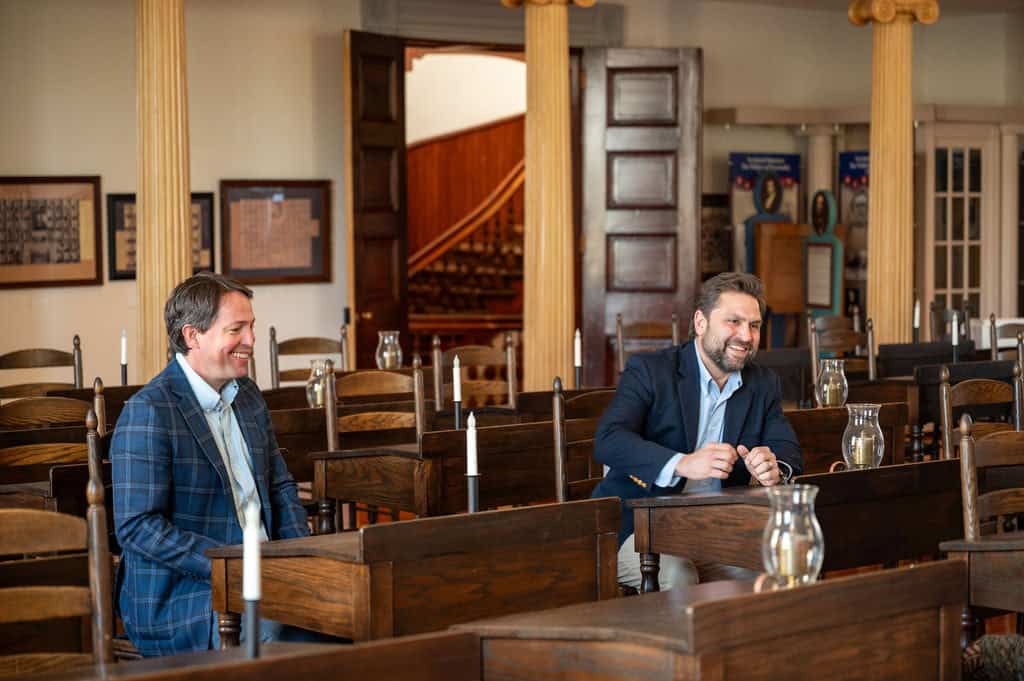
“It was intentional,” says Dismang of their collaboration. “There was a [legislative] session and we sat down and said: ‘We’re going to work on some things together. What do you care about that we can care about together?’” They discussed homelessness and food insecurity, and Dismang says that “there were other causes that popped up in that conversation. Hey—no matter what, we can work together on these issues, right?”
“That’s right,” Tucker chimes in, “we sat down on purpose and asked, ‘What can we work on together?’”
Dismang had already established himself as a leader in the Senate when Tucker was first elected to the House of Representatives. “I’m a lowly House member, and he was pro tempore of the Senate. He was up here.” Tucker gestures upwards with his hands. “I admired the way that [Dismang] worked, even though we weren’t interacting a lot,” he explains. “I could just tell from the beginning that he’s trying to keep things from going off the rails,” he laughs. “But I think we really started to be buddies once I got to the Senate.”
When Tucker’s son attended an overnight basketball camp at Harding, they decided to meet up. “I said, ‘Hey, let’s go to Who Dat’s,’” Dismang recalls. The two legislators had dinner and got to know one another. “We were there a lot longer than we probably should have been,” Dismang says. “It was a great meal and good fellowship.”
Tucker says his first session as a member of the Senate was difficult. Halfway through the session at an event in Cabot, Dismang approached with a question. “A lot of members were there, but Jonathan came up to me and asked, ‘How are you doing?’” Tucker remembers. “It wasn’t a casual, ‘Hey, what’s up?’ It was sincere. I could tell he’s a good man. He was checking in on me and he still checks in on me, to this day,” Tucker smiles. “He’s a good friend.”
I want to make an impact. So the only way I can do that is to work with Republicans.
Senator Clarke Tucker
Dismang says Tucker is well-respected in the Senate. “He has a constituency that needs to be heard, and so he’s going to go to the well, and he’s going to make statements for them. It’s not because he’s grandstanding. It’s not because he needs a microphone. It’s because he feels like people need to be represented, and so people respect that.” Tucker serves as Dismang’s counselor when needed. “He’s, you know, the angel on my shoulder,” Dismang laughs. “Not just for me, but for the entire Senate sometimes.”
Being a member of the minority party (there are six Democrats and twenty-nine Republicans in the Arkansas Senate) is a challenge for Tucker and his fellow party members. “I want to make an impact. So the only way I can do that is to work with Republicans.” He points out that Dismang and members of his party aren’t forced into bi-partisan relationships. “You know, he doesn’t have to work with me, but he chooses to anyway.”
“In fairness,” Dismang adds, “when I started, we were in the minority in the House and in the minority of the Senate. So, I do understand the situation and I was allowed to have leadership roles and be engaged.”
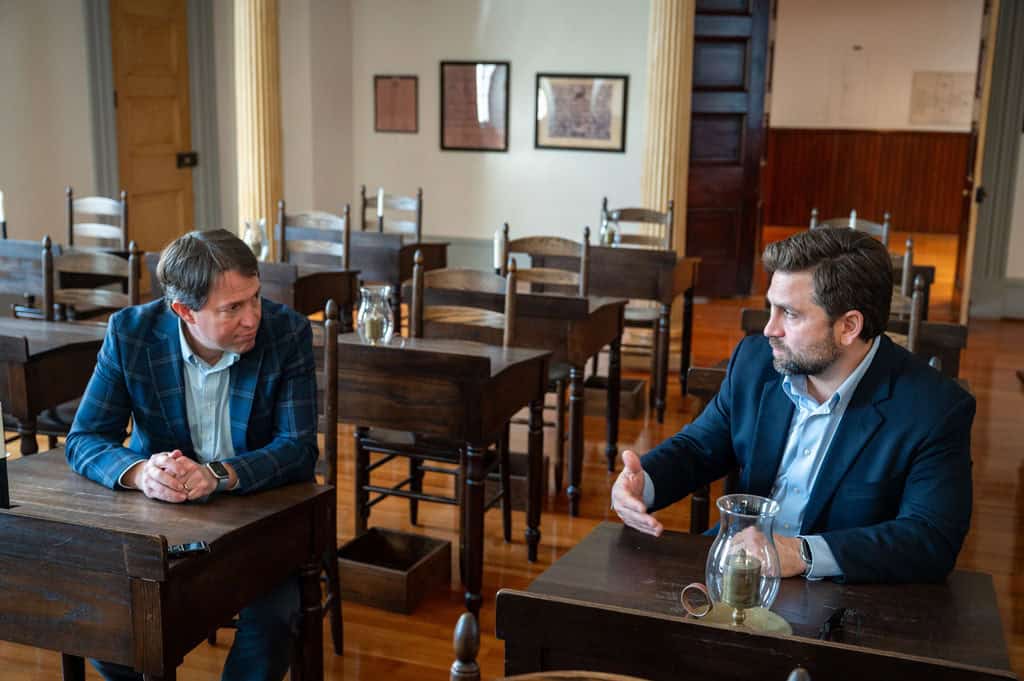
The two men have heavy conversations and acknowledge that Arkansas lives at the bottom when it comes to the list of important state statistics: education, health, maternal health, voter participation, and food security. “I think we should always be looking to improve systems,” says Dismang. He’d like to address homelessness. “What to do there? It’s very multi-layered and I feel like it’s getting worse,” he says. “And so how to tackle that? How can the state help that? I still don’t even know how to wrap my head around it yet.” For Tucker, justice reform and recidivism are important and he says they are “having that conversation, trying to figure it out.”
This across-the-aisle friendship isn’t always hearts and roses. “We disagree on a lot of things,” says Dismang, “and he’ll come tell me because he’s not shy about it,” but those differences don’t end in hostility. “Sometimes he’s able to have an influence on the way I vote, because he provides a different perspective. We come from different places.”
“That’s the beauty of democracy, you know?,” replies Tucker. “To me, disagreeing on policy, that’s just the democratic process playing out.” Maintaining honest communication is an important component of their collaboration. “We’re very open with each other. There’s no hiding the ball.” He says they talk through policy often, even when it’s “not something big like universal breakfast.”
Get less news from your social media and have more face-to-face conversations with your neighbors.”
Senator Jonathan Dismang
Both legislators say they maintain broad relationships and encourage others to engage in conversations with people who share different backgrounds and ideas. “You know, Mike Beebe is from Searcy,” says Dismang, “and I would say he did not like me very much and he would tell you that he did not like me very much at the start, but at this point, he’s a mentor and more in some ways.”
Tucker interrupts, “Beebe told me about a time he publicly scolded Jonathan,” he chuckles. “He was governor and Jonathan was a new legislator, and he did the scolding in Jonathan’s legislative district,” Tucker emphasizes the seriousness of the offense with his voice. “He told me how much he had come to like Jonathan. He said, ‘I go out of my way now to praise Jonathan to make up for that, because he means business. He does things the right way.’”
Tucker says he wants people to feel comfortable talking about politics with others. “You may realize that even though you disagree on policy, you still have a lot in common.” Just because your neighbor doesn’t share your political party doesn’t mean they don’t care.
Dismang says he thinks it would help if folks would watch less news. “I don’t care which station you’re watching, I’m not picking a side on that. Get less news from your social media and have more face-to-face conversations with your neighbors.”
Tucker agrees, adding, “And expose yourself. Your situation isn’t like everyone else’s. Go out and have experiences and try to better understand what other people’s lives are like.”
Other agreements? They share a disdain for national politics and a preference for print media. Both are focused on impact and choosing areas where they feel can help the people they represent. “I want to work on pieces of legislation that are of consequence,” says Dismang. “We’re hopeful when all is said and done, we’ve moved the needle for the better.”

What’s next on their bi-partisan slate? They are working on film incentive legislation. Tucker says he wants to talk about SNAP accessibility. There’s more work to do on school meals. “We definitely want to take a shot at lunch,” says Tucker. Free lunch would be the final part of a three-phase childhood hunger policy package he and Dismang began with the reduced price co-pay. “We did the smallest piece first,” Tucker explains. The second piece was free school breakfast and the last piece, free school lunch, would ensure all Arkansas school students have access to healthy meals throughout the school day, “and it’s the biggest piece,” he says.
“I think everybody’s goal is people being able to have what they need, to lift themselves up and out,” says Dismang, “be self sufficient, you know, follow their own path and dream.”
While the 10th graders dominated the men after our interview concluded, I observed the melee from the back of the room with group chaperones and school staff members. One of them asked me the names of the legislators I’d just introduced and how they were connected to free school breakfast. “Oh, please tell them that free school breakfast has made such a difference at our school,” she pleaded. “It would be incredible to offer free lunch.” It felt great to tell her in a whisper, “I think they’re working together on that.”

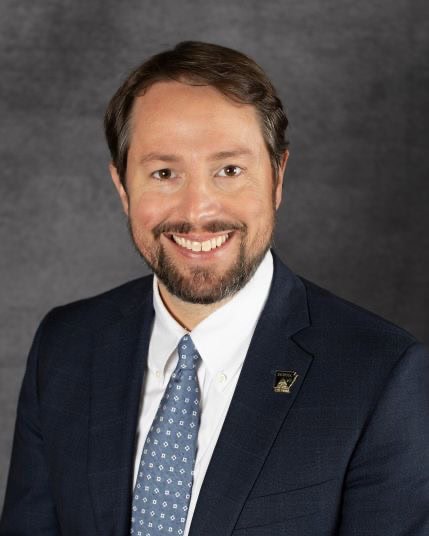
Senator Clarke Tucker, District 14
District 14 runs from downtown Little Rock through Chenal Parkway, including all neighborhoods between the Arkansas River and I-630.
BIRTHDAY: January 20, 1981
HOMETOWN: Little Rock (Pulaski County)
HIGH SCHOOL: Little Rock Central High School
COLLEGE: Harvard University
LAW SCHOOL: University of Arkansas
STUDY FOCUS: Government
FIRST JOB AFTER COLLEGE: “I went straight to law school, so I was working for law firms in the summers.”
DREAM JOB: “You know, my dream job would be the center fielder for the St. Louis Cardinals.”
CHURCH: Trinity Episcopal
FAMILY: Married, two children
PETS: A Goldendoodle, Scuppers

FAVE HOLIDAY MOMENT: “For me, Christmas celebration kind of starts with the church service on Christmas Eve and all the Christmas carols. And my mom makes sweet rolls for breakfast every Christmas morning.”
Want to know more about Senator Tucker? Read his official bio.

Senator Jonathon Dismang, District 18
District 18 includes White County and parts of Faulkner and Cleburne Counties.
BIRTHDAY: July 30, 1979
HOMETOWN: Maynard (Randolph County) & Beebe (White County)
HIGH SCHOOL: Beebe High School
COLLEGE: Harding University
STUDY FOCUS: Accounting and Economics
FIRST JOB AFTER COLLEGE: “An accounting firm in downtown Little Rock. I was in their healthcare audit.”
DREAM JOB: “I love to cook. So if there was a way to do that… I don’t think I would be good enough, but I would enjoy it.”
CHURCH: Church of Christ
FAMILY: Married, two children
PETS: Two Doodles, Scout and Finley

FAVE HOLIDAY MOMENT: “Waffles with peanut butter on Christmas morning with my in-laws. That’s a huge thing for us.” Afterwards, the family gathers with his parents and relatives. “We are a big family on the Dismang side, so we spend a lot of time just being around everyone.”
Want to know more about Senator Dismang? Read his official bio.
Special thanks to the Old State House Museum staff. Admission to the museum is free and open to the public Tuesday through Saturday, 9 a.m. – 5 p.m. and Sunday, 1 p.m. – 5 p.m.
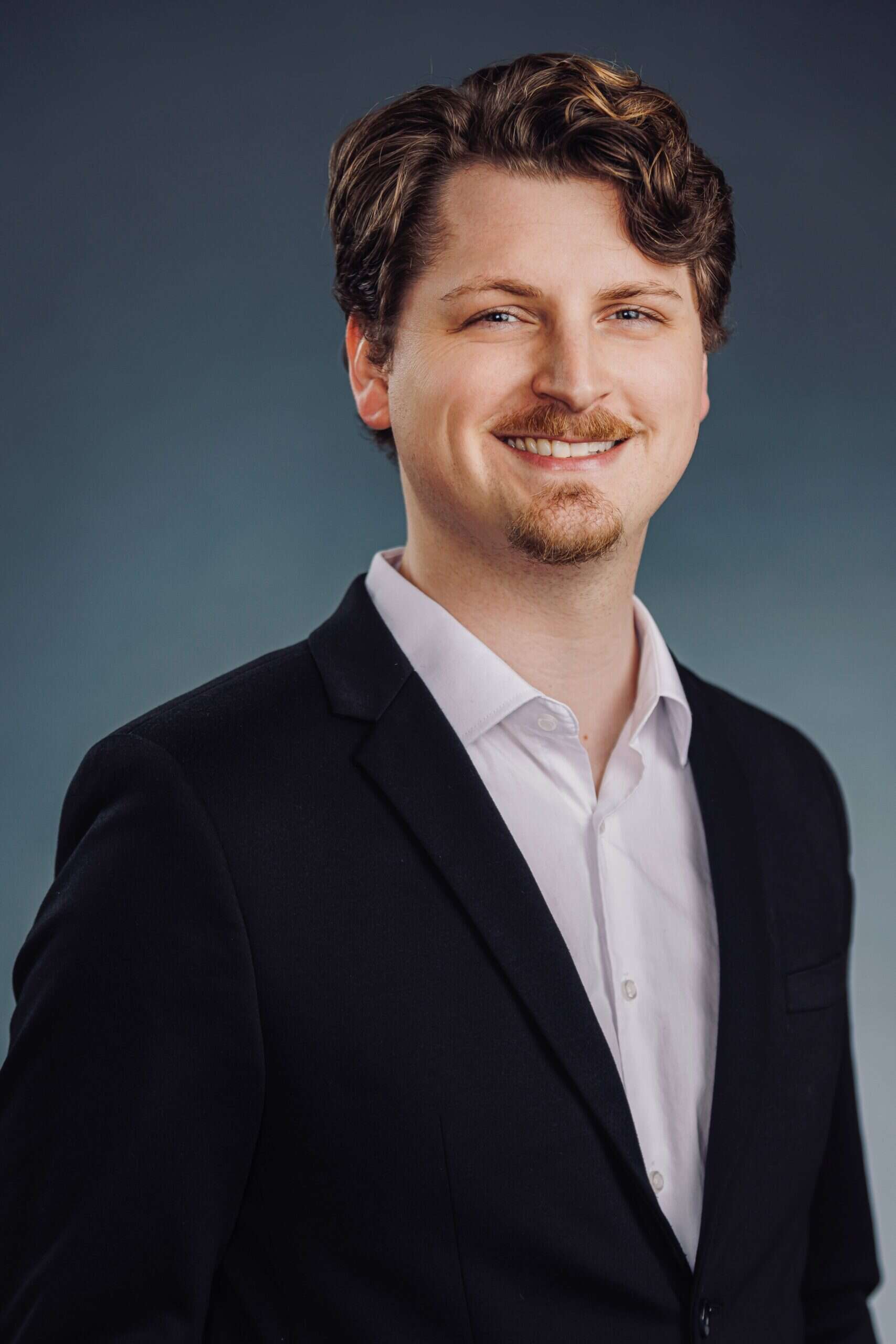
T. Logan Keown is a photojournalist and visual artist whose work is shaped by honesty and curiosity. A veteran with nearly a decade of service in the U.S. Navy as a Mass Communication Specialist, his award-winning photography blends technical skill with a storyteller’s heart. Originally from Arkansas, Logan is reconnecting with the place that shaped him and spending time nurturing creative projects. Follow him on Instagram and find his work online.
Jessica Crenshaw serves as Editor in Chief and Director of Programming at Arkansas Strong. A life-long Arkansan, she enjoys writing about interesting people and beautiful places in her home state.